
Choosing the right moment to lift a tree is crucial for successful planting and good establishment. This moment is influenced by several factors, including the tree’s physiological dormancy, the species, the season, transport and storage conditions, and the circumstances at the final planting site. In consultation with the nursery, the optimal lifting time can be determined. In this article we discuss the key points to consider.
When is a suitable time to lift a tree?
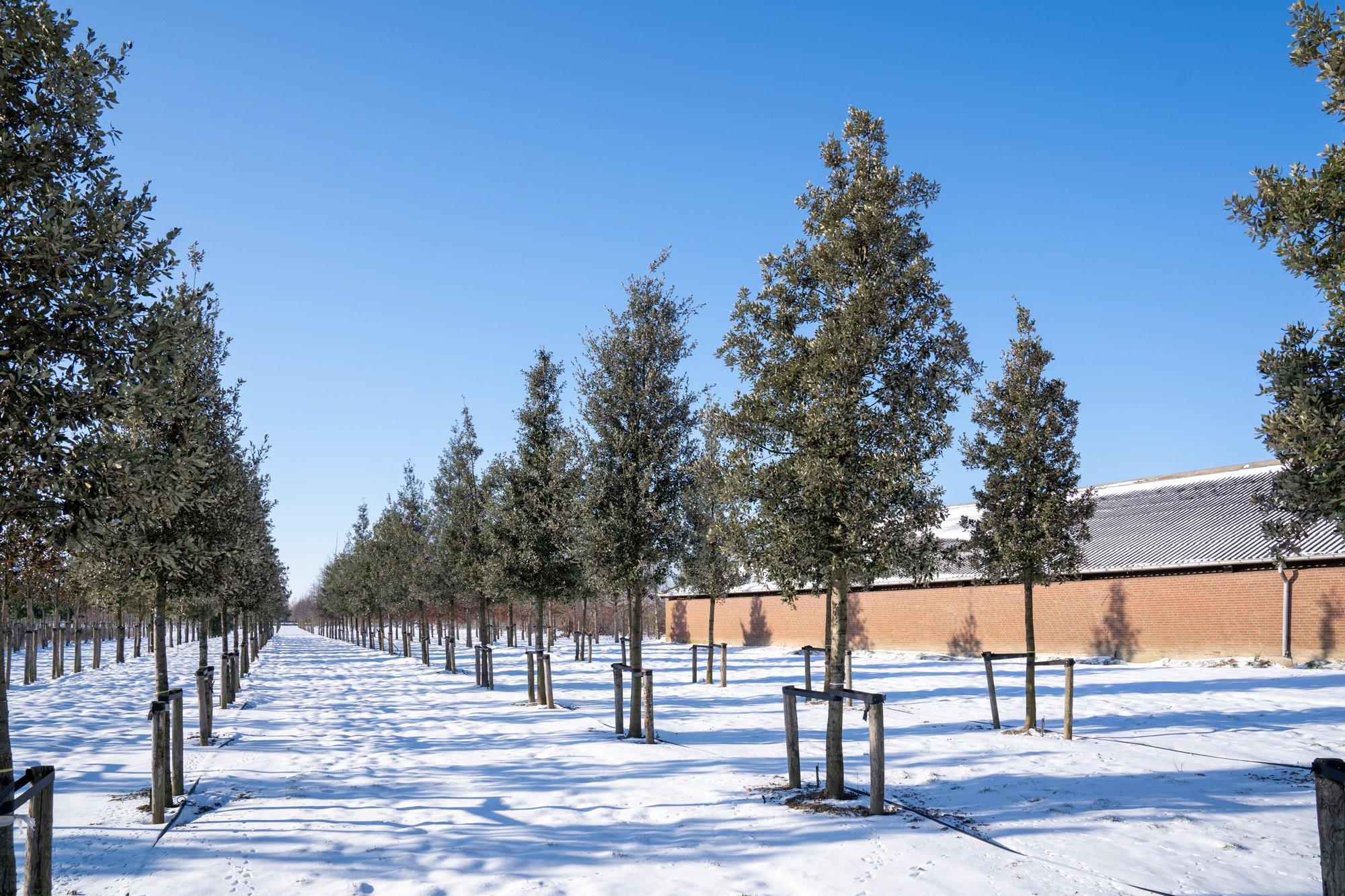
In principle, the right time to lift a tree from open ground is always during winter, from early November to early April. During this period, most deciduous trees are in winter dormancy. They have shed their leaves, sap flow is greatly reduced, and energy is stored in the roots and trunk. This allows the tree to tolerate transplanting much better.
The exact timing of leaf fall varies by species and is strongly influenced by weather conditions. A mild autumn with warm nights and little wind can cause trees to retain their leaves for longer. A more consistent and decisive factor, however, is day length. As days shorten and light intensity decreases, deciduous trees respond by initiating leaf fall. Most species follow this natural rhythm. Once a tree is dormant, it can be safely lifted. For many species, this does not necessarily mean that all leaves must have fallen. Species such as Quercus robur (English oak) and Fagus sylvatica (beech) are preferably lifted when the leaves have turned brown or have fallen completely.
What do we mean by lifting?
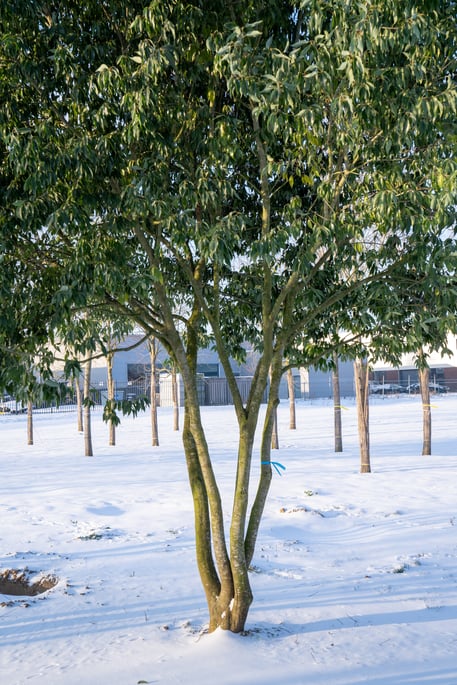
In tree nurseries, lifting is a key operation, as it largely determines the quality of the plant. By lifting, we mean removing trees from the ground with the aim of transplanting them or supplying them to the customer. Lifting is therefore essentially the harvesting of plants. When a harvesting operation takes place below ground, we use the term lifting.
Align lifting with the planting date
It is important to align the lifting date with the planned planting date. Most trees can, if handled correctly, be stored above ground for a long time without loss of quality. It is therefore perfectly possible to lift trees early in winter and plant them later in the season. If frost occurs during storage or transport, appropriate measures must be taken to prevent desiccation and frost damage. More useful tips on planting trees during the winter period can be found in this article. Lifting a tree slows down its growth process and delays bud break. If it is known in advance that a planting project will only take place late in spring, it can be strategic to lift trees early in the season. This reduces the risk of damage caused by premature flushing.
Sensitive tree species
Most trees can be lifted in autumn once the first leaves begin to fall. However, there are a number of species that must be fully dormant to significantly increase the chance of successful establishment. In the Dutch climate, where the trees from Boomkwekerij Ebben are lifted, this means they should only be lifted from 5 December onwards. Sensitive species in this category include oaks, with the exception of evergreen oaks which are even more sensitive, beeches, and willows. Lifting these species too early greatly increases the risk of failure.
An overview of evergreen deciduous trees: Ilex aquifolium, Ilex x koehneana, Magnolia grandiflora, Quercus ilex, Q. suber, Q. x hispanica, Q. x turneri, Q. glauca, Q. myrsinifolia.
Evergreen deciduous trees require extra attention
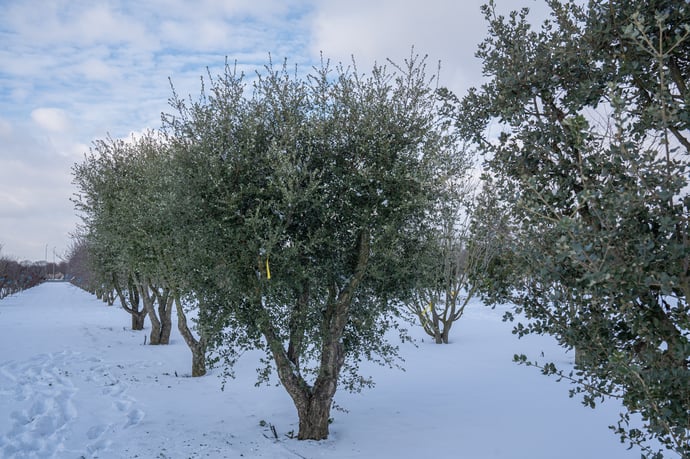
Evergreen deciduous trees form a distinct category. For species such as holm oak Quercus ilex and Quercus x turneri ‘Pseudoturneri’, the correct lifting time is critical. This group of trees is never fully dormant, as they retain their leaves and therefore remain active. The ideal lifting time is early spring, when the buds begin to swell. At that point the root system is already active, but the tree has not yet entered its growth phase. Once new shoots become visible, the tree is fully active and the risk of establishment failure increases sharply. Important points of attention for evergreen deciduous trees include:
- Keeping the time between lifting and planting as short as possible, preferably planting immediately.
- Minimising transpiration as much as possible.
- Protecting the trees from wind and sun during transport and handling.
Surprisingly, there are also some evergreen trees that transplant easily, such as Magnolia grandiflora and Quercus suber. They often respond after planting with heavy leaf drop, but then recover quickly.