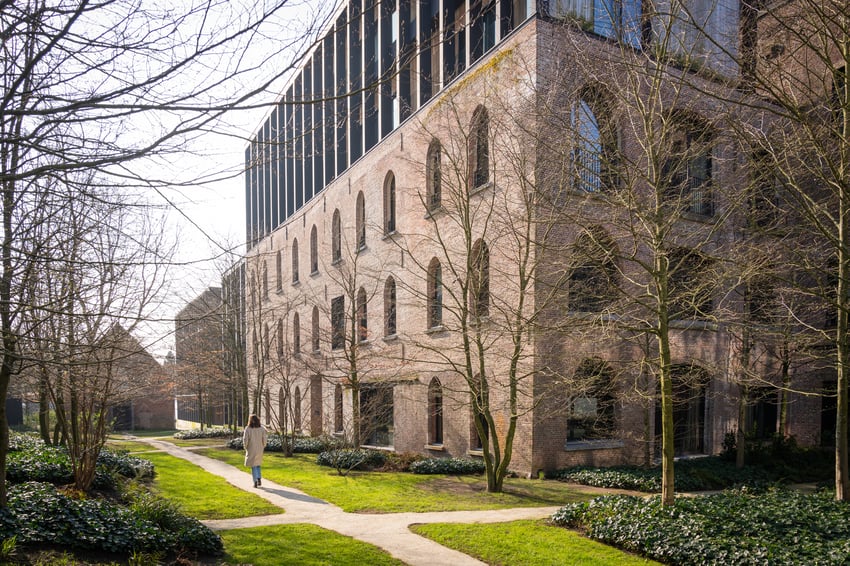
The city of the future needs more than just additional green space. It needs greener areas that are more diverse, better connected and more thoughtfully designed. As cities become denser and space comes under increasing pressure, nature is becoming increasingly fragmented. Parks, tree-lined streets, waterways and green squares often exist as isolated islands within the urban landscape. For many species, this means that suitable habitats become inaccessible. For people, it often results in a warmer, less healthy and less attractive living environment.
The solution is not simply to add more individual green spaces, but to design a coherent ecological network. A network in which large green areas function as core habitats, smaller green spaces serve as stepping stones, and tree-lined streets, verges and waterways act as corridors connecting these areas.
This creates an urban ecosystem in which species can move through the city and where green infrastructure performs several functions at once: supporting biodiversity, climate adaptation, water retention and quality of life.
The future of urban greening therefore does not lie in choosing between more trees or more low-growing vegetation. The greatest value is created by connecting different vegetation structures: trees as the backbone, complemented by shrubs, perennials, herbaceous vegetation and water. Together, these elements create resilient urban ecosystems.
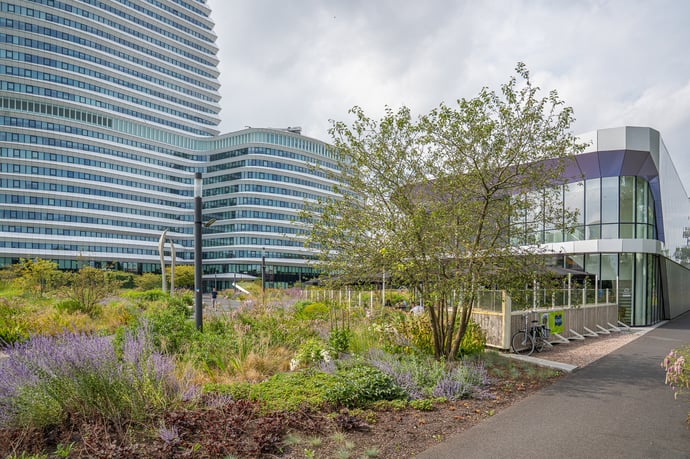
What are ecological corridors?
An ecological corridor is a green structure that connects different habitats and allows species to move through the urban environment. It can take the form of a large park corridor or riverbank, but also a network of smaller green elements such as tree-lined streets, flower-rich verges, green roofs, green façades and courtyards.
Within urban areas, a distinction is often made between:
Macro-connections
Large-scale green structures such as urban forests, parks, avenues, cemeteries, stream valleys and riverbanks. These form the main framework of the ecological network.
Micro-connections
Smaller green elements that function as so-called ‘stepping stones’. Examples include green squares, pocket parks, groups of trees, gardens, green roofs and façade planting. The real strength lies in the interaction between these different scales. A large park that is completely isolated has less ecological value than a network in which major green areas are connected by smaller green stepping stones. For a butterfly, bat or bird, it is not simply about reaching one destination, but about having enough suitable places available along the way.
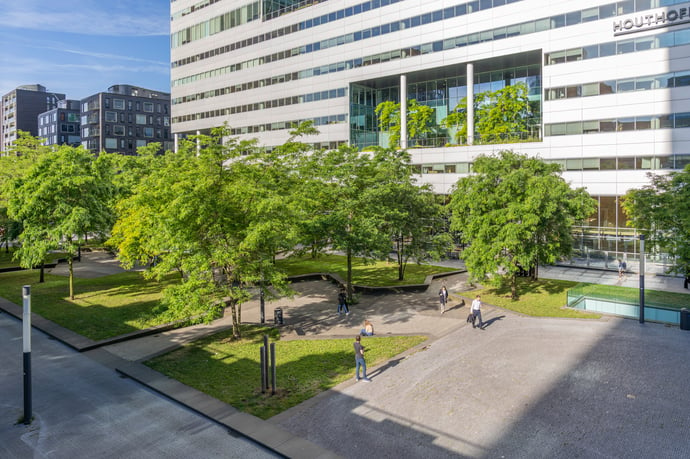
Enhancing biodiversity through connectivity and
diversity
An ecological corridor, ecological connection or green-blue network is more than simply a route from one green space to another. The quality and structure of the planting determine whether species can actually use these connections.
A diverse vegetation structure creates different habitat layers, ranging from ground vegetation (grasses, ferns and mosses), early-flowering bulbs and perennials to shrubs and mature trees. Each layer performs its own function. Flowering plants provide nectar and pollen as food for pollinating insects, shrubs offer shelter and nesting opportunities, while trees provide structure, food and movement routes for birds, bats and insects. Trees add a unique dimension. Thanks to their height, canopy volume and deep root systems, they continue to perform important ecological functions even during periods of drought. Combined with lower vegetation layers, they extend the period during which food is available and create a wider variety of habitats. This habitat diversity makes urban eco-systems stronger and more resilient. An ecological connection consisting solely of mown grass or a single row of trees has a very different ecological value from a network in which multiple vegetation layers complement one another.
Future-proof urban greening is therefore not simply about creating more green space, but about creating better-designed green space.
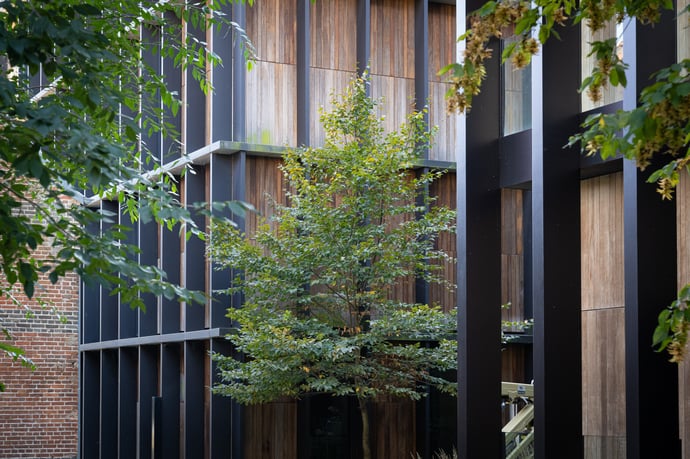
Trees as the backbone of the urban ecosystem
Trees form the vertical structure of the city. They connect the different layers of the urban ecosystem and provide functions that cannot be fully replaced by any other group of plants. A mature and healthy tree provides shade, cooling, carbon storage, nesting opportunities and food for countless species. Trees also act as natural landmarks and connecting elements for many animals. Bats use rows of trees as navigation routes, birds move along green structures, and insects benefit from flowers, shelter and the microclimates that develop around trees.
Suitable tree species for urban ecological corridors combine high ecological value with the ability to adapt to changing climatic conditions. Examples include:
- Oaks such as Quercus pubescens – among the most valuable trees for biodiversity, supporting a wide variety of insects, birds and mammals.
- Lime trees such as Tilia cordata and Tilia tomentosa – an important food source for pollinators.
- Carpinus betulus – A native urban tree with character and high ecological value.
- Maples such as Acer campestre, Acer cappadocicum of Acer monspessulanum – well suited to urban conditions and attractive to insects.
- Alders such as Alnus glutinosa and Alnus spaethii – valuable alongside waterways and bioswales.
- Elms such as Ulmus ‘New Horizon’ – a future-proof elm suitable for urban applications.
- Trees from the elm family such as Celtis sinensis – robust trees that tolerate heat and drought well while also contributing to biodiversity.
- Members of the legume family such as Styphnolobium japonicum, Cercis siliquastrum, Robinia ‘Nyirségí’ highly valuable to pollinators and capable of enriching soils through nitrogen fixation.
-
Elaeagnus × ebbingei, Ligustrum vulgare and Osmanthus × burkwoodii are evergreen species that produce abundant blossom and provide a rich source of nectar for pollinators.
The greatest benefit, however, is achieved when trees are not used as isolated elements but form part of a broader vegetation structure that also includes shrubs, perennials, herbaceous vegetation and water.
New green typologies for a connected city
The complex challenges facing modern cities require new approaches to design. Traditionally, public green space often consists of separate elements: a row of trees along a street, a lawn in a park or a shrub or planting bed surrounding a building. An ecological network requires green typologies in which multiple functions come together. Not every green element needs to be the same. In fact, it is precisely the diversity of structures that makes a network strong. A group of trees can function as a cooling climate buffer, a flower-rich verge as a feeding area for pollinators, and a bioswale as both a water-retention system and an ecological connection. New green typologies, such as tree-planted bioswales, urban climate forests and urban hedgerows, combine landscape principles with urban needs. A tree-planted bioswale, for example, combines water retention with a layered tree structure and underplanting. An urban hedgerow brings a traditional rural landscape element into the city, using trees and shrubs to create a valuable linear ecological connection.
This approach reflects the development of urban green structures in which individual planting areas are no longer the main focus. Instead, they become part of a network of different green building blocks. Each place has its own function while simultaneously contributing to the wider ecological system (De Wolf & Tillie, 2024).
From urban forest cores to urban savannas: the strength of layered vegetation
When designing climate-resilient cities, the assumption is often that the more trees there are, the better. Trees are indeed essential for cooling, but recent research into urban microclimates shows that the number of trees is not the only determining factor.
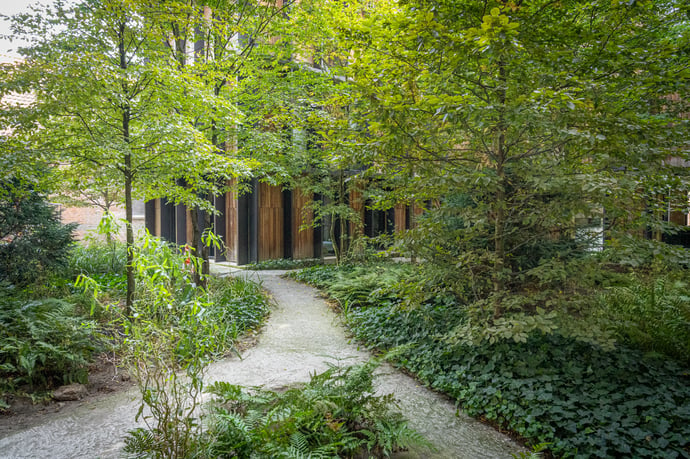
How vegetation is structured, and whether trees are able to grow healthily into maturity, also plays a major role in determining how an area performs. Research by Beele et al. (2024) shows that different urban environments require different types of green structure. A dense tree canopy can provide substantial cooling during the day, but under certain conditions it may restrict cooling at night. With less visible sky, heat is less able to radiate away. Optimal design therefore requires a balance between shade, evapotranspiration, air circulation and night-time radiative cooling. A future-proof city should consequently consist of a mosaic of different vegetation types. Urban forest cores — compact tree structures with a woodland character — can be alternated with urban savannas: open, layered green spaces containing individual trees, shrubs, perennials and species-rich herbaceous vegetation.
A more varied vegetation structure can therefore perform better throughout the entire day and night. This combination creates an effective balance between shade, evapotranspiration, biodiversity and air circulation. At the same time, it creates a wider variety of habitats for plants and animals.
Ecological corridors as climate-adaptive infrastructure
Ecological corridors are not only important for biodiversity. They also represent an important strategy for adapting cities to climate change. As temperatures rise and extreme rainfall becomes more frequent, the need for green-blue infrastructure continues to grow.
Trees play a key role in this. Their canopies provide shade and reduce the heating of buildings and paved surfaces. Through evapotranspiration, trees contribute to cooling and improve the local microclimate. Shrubs, perennials and ground-cover plants complement these functions by protecting the soil, retaining moisture and creating additional habitats. A diverse vegetation structure can also respond more robustly to changing conditions. Combining different species and vegetation layers creates greater stability. When one species comes under pressure from drought, heat or disease, other parts of the system can continue to function. Combining ecological corridors with bioswales, waterways and infiltration systems creates a green-blue network capable of addressing several challenges simultaneously: flooding, heat stress, biodiversity loss and the need for attractive public spaces.
Green routes encourage walking and cycling, reduce stress and support mental well-being. People have been shown to feel more comfortable in environments where nature is visible and accessible. Green connections also provide residents with easier access to recreational green spaces.
Inspiring examples from across Europe
Several European cities demonstrate how green networks can become an integral part of urban development. In Copenhagen, the 'Five Finger Plan' has provided the basis for an urban model in which development and green areas are planned together since 1947. Green zones between urban corridors are preserved as ecological and recreational connections. In Oslo, the 'Pollination Highway' demonstrates how a network of small interventions — such as flower-rich areas, green roofs and nesting opportunities — can collectively create habitat for pollinators. The city Hamburg has developed an extensive 'Green Network' in which green corridors guide residents through the city while connecting natural areas. Stuttgart is situated in a valley and protects green ventilation corridors that draw cool air from the surrounding hills into the city. Similar structures are sometimes referred to as ‘breezeways’ in other cities.
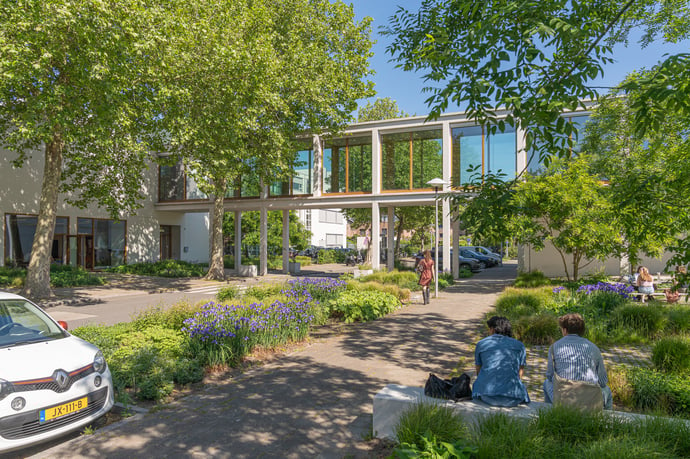
Dutch cities are also increasingly investing in green-blue networks that integrate trees, water, biodiversity and climate adaptation.
The green city of tomorrow starts today
Ecological corridors are not a luxury in a growing city. They are essential infrastructure for the future. They connect natural areas while contributing to climate adaptation, biodiversity and human health.
The challenge is not simply to add more greenery, but to design green spaces that perform multiple functions simultaneously. By using trees as the structural backbone and combining them with shrubs, perennials, species-rich herbaceous vegetation and water systems, we can create an urban landscape that is stronger, cooler and more biodiverse. Creating these green networks requires trees of sufficient size and quality, as well as adequate genetic diversity. The choices made in tree nurseries today therefore help determine the ecological and climatic quality of the cities of tomorrow.
The green city of tomorrow emerges when we stop seeing greenery as decoration and start seeing it as a living system: a system in which trees form the foundation and every green connection contributes to a future-proof city.
Sources
Threlfall et al. (2017) – urban greening and biodiversity.
Beninde et al. (2015) – habitat heterogeneity and urban biodiversity.
Konijnendijk van den Bosch (2021).
De Wolf & Tillie – Ecologisch netwerk vraagt nieuwe groentypologieën.
Beele et al. (2024), Urban forests or urban savannas? Smart cooling tailored to time and place. Landscape and Urban Planning.